Recently I lost a friendship over a misunderstanding that, on the surface, seems almost absurdly small. But as painful as the experience has been, it has made me think more deeply about the meaning behind the You Matter Card project and why I started it in the first place.
The misunderstanding began when I told my friend Marty that I had finally managed to inject myself with Zepbound, a medication prescribed and medically supervised by my endocrinologist.
I said that I wanted to “surf that wave.”
What I meant was simple: I had just accomplished something that had frightened me for most of my life, and I wanted to carry that sense of accomplishment into another challenge.
Marty heard something entirely different.
He wondered whether I was talking about injecting recreational drugs. Even after I explained that I meant my prescribed medication, he referred to experiences with addicts who had lied convincingly about drug use. Later, when I tried very hard to demonstrate that I was telling the truth, he said my response resembled what he regarded as a warning sign of an addictive personality in denial, while also saying that he was not directly accusing me of being one.
It would therefore be inaccurate for me to say that he literally called me a “lying addict.”
But I certainly experienced the conversation as being treated as though I might secretly be an addict who was lying about it.
And one lesson I have taken from this experience is that accuracy still matters when we are hurt.
The reason injecting myself meant so much to me goes back to something that happened when I was a child in Vancouver.
One day I found a discarded syringe in a local park. I did not understand what I had found. To me it was simply an interesting object, so I brought it home.
My mother was an anesthesiologist.
She understood immediately what a discarded syringe might represent and the dangers associated with it. She reacted very strongly.
As an adult, I understand why.
As a child, however, what stayed with me was fear.
From then on, needles frightened me. That fear remained with me for decades.
So when, at 55, I finally managed to inject myself with medication prescribed by my endocrinologist, it felt like an enormous personal victory. I had done something by myself that I had genuinely doubted I would ever be able to do.
That was the wave I wanted to surf.
When Marty became suspicious about what I meant, my instinct was to prove that I was telling the truth.
I offered to show him my Zepbound. I offered to let him speak directly with my psychiatrist. Then I offered my primary-care physician and endocrinologist as well.
My reasoning seemed straightforward to me. These were the medical professionals who knew my actual medical history. If my word was not enough, perhaps the people responsible for my health care could reassure him.
I thought I was saying:
You don’t have to take my word for it. Here are people who can verify what is actually happening.
But Marty interpreted the intensity of that response differently.
The very fact that I was willing to go so far to establish that I was telling the truth became another reason for him to be concerned.
And that taught me something difficult.
Sometimes there comes a point when trying harder to prove yourself no longer produces understanding.
I could have offered another explanation, another doctor, another piece of evidence or another reassurance. But once my efforts to defend myself had themselves become suspicious, there was nowhere productive for the conversation to go.
Eventually Marty ended our friendship and made clear that he did not want me visiting him or participating in future games or social activities.
I respect that boundary.
I do not have to agree with another person’s interpretation of me in order to respect their right to decide whom they want in their life.
And Marty ultimately acknowledged something important himself: I was not the people from his past. He recognized that some of what was happening was unfair to me, but he also realized that continuing our friendship would require an emotional investment he was not willing to make.
I wish things had ended differently.
But I cannot control that.
What I can control is what I learn from it.
And this is where the experience connects to the larger meaning of the You Matter Card.
The phrase You Matter is easy to believe when everything is going well.
It is easy to tell someone they matter when they are healthy, employed, housed, emotionally stable, agreeable and easy to understand.
The phrase becomes much more important when none of those things are true.
Do you still matter when you are mentally ill?
Do you still matter when you are homeless?
Do you still matter when you have an addiction?
Do you still matter when you have relapsed?
Do you still matter when other people find your behaviour difficult?
Do you still matter when you need help repeatedly?
Do you still matter when your illness has hurt people who love you?
I believe the answer has to be yes.
That does not mean that everything a person does must be accepted.
It does not mean abandoning boundaries.
It does not mean tolerating abuse, manipulation or dangerous behaviour.
It means that underneath all of those circumstances there is still a human being.
That conviction is deeply personal for me because substance use disorder has touched my life repeatedly.
Marty had told me that both of his parents had alcohol use disorder. He remembered giving them money and seeing it disappear into alcohol. He even remembered buying birthday presents for himself because of what alcohol had done within his family.
I understood something of that pain.
My own sister died from alcohol use disorder.
She is the person to whom I dedicated the You Matter Card.
I have also had an uncle with alcohol use disorder. A former boss died from alcohol use disorder. A friend from college died from a substance use disorder involving heroin.
I have watched illness destroy health, relationships and lives.
But those experiences did not convince me that people with addictions are morally defective.
They convinced me of almost the opposite.
They convinced me that human beings can become very sick.
I do not see substance use disorder as evidence that someone is evil or weak. I do not see it as a supernatural curse, a punishment from a god or some great battle between good and evil.
I see illness.
It is a complicated illness involving biology, psychology, environment, behaviour, trauma and circumstance.
And yes, people who are sick can hurt other people.
Calling something an illness does not erase responsibility for behaviour.
Families still need boundaries.
Friends sometimes have to walk away.
Other people have the right to protect themselves.
But illness should never become an excuse for stripping someone of their humanity.
My own experience with alcohol and recreational drugs was very different.
When I was young, I spent a summer in France. Drinking alcohol was culturally ordinary among my relatives, and eventually I gave in to persistent pressure from my cousins and drank.
At 19, I became extremely drunk while celebrating a best friend’s birthday.
The experience went badly enough that I told myself I never wanted to repeat it.
Years later, at 26, I drank with a workmate and became drunk again. Another coworker had suggested that this person and I had developed some extraordinary connection. Afterwards, I realized that nothing especially profound had happened.
We had simply gotten drunk together.
That was the last time I drank alcohol.
Around the age of 30, curiosity even took me to Amsterdam intending to try marijuana.
When I got there, I chickened out.
Instead, I somehow ended up watching an incredibly boring sex show before discovering things that were far more exciting to me: the Anne Frank House and the Rijksmuseum, with the work of artists such as Van Gogh and Gauguin.
Recreational drugs simply never became part of my life.
But something became clear to me after what happened with Marty.
When I defend myself against the suggestion that I have a substance use disorder, I do not want my defence to become:
I am not one of those people.
Because some of “those people” were people I loved.
My sister was one of them.
That distinction is central to what You Matter means to me.
I can say:
That isn’t my illness.
without saying:
And therefore I am better than somebody who does have that illness.
I can reject a false assumption about myself without accepting the stigma contained within it.
When I see someone struggling with addiction or homelessness on the streets of Vancouver, I often think about my sister lying in a hospital in Richmond, dying from alcohol use disorder.
She was not a category.
She was not an “addict.”
She was not a morality lesson.
She was my sister.
She mattered.
I also remember something my father used to say.
During his years working as a Catholic priest in Vancouver’s Downtown Eastside, he came to believe that at some point a person had to recognize that they were sick and ask for help.
That idea stayed with me because, although my own illness was completely different, I eventually had to do something very similar.
There was a period in my life when I was homeless and living in a tent around Vancouver while experiencing serious mental illness.
Substance use had nothing to do with it.
There was no single simple explanation for why I became sick.
There was enormous stress from work. There were likely biological and genetic factors. There was my environment. There may have been a contribution from a pituitary adenoma. Circumstances accumulated until eventually I became seriously unwell.
I did not choose mental illness.
I did not choose homelessness.
I did not wake up one morning and decide that living in a tent while my life disintegrated sounded appealing.
I became ill.
Eventually I had to ask for help.
And I was fortunate.
When I reached the point where I could accept help, there were people and systems available to help me. Those systems were not perfect, and recovery did not happen overnight, but people helped me as best they could.
Eventually I found stability again.
Not everybody gets that opportunity.
Some people ask for help and encounter waiting lists.
Some are turned away.
Some are too frightened to ask.
Some are so ill that they cannot recognize how sick they have become.
Some have lost every relationship they once depended upon.
Some relapse.
Some encounter systems without enough resources.
Some die before the right help reaches them.
And sometimes the person we are walking past today could have been us under slightly different circumstances.
That is one of the ideas at the heart of the You Matter Card.
A person in crisis should not first have to demonstrate that they are worthy of compassion.
The purpose of saying You Matter is not to reward somebody for having lived correctly.
It is to recognize something that was already true.
You matter because you are a human being.
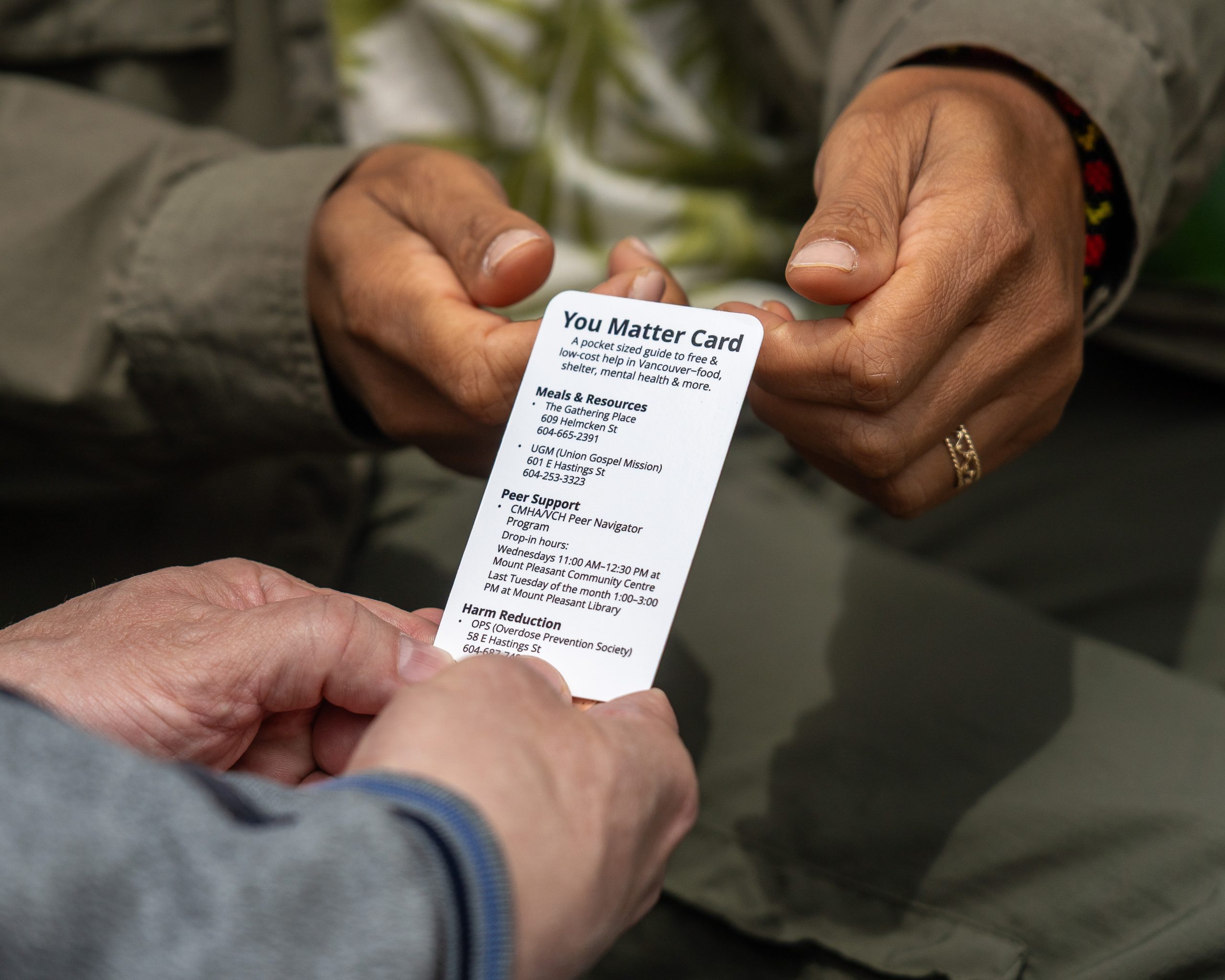
The card is therefore more than a collection of information or resources.
To me, it represents a small interruption in the process by which people become invisible.
Someone may be homeless.
Someone may be hungry.
Someone may be experiencing psychosis.
Someone may have an alcohol or substance use disorder.
Someone may have made mistakes.
Someone may have alienated their family.
Someone may not be particularly pleasant to interact with at that moment.
But none of those statements means that the person’s life has ceased to have value.
The practical resources matter because people need food, shelter, health care, treatment and human assistance.
But there is another message underneath all of that:
We still see you.
You are still one of us.
Your illness is not the entirety of who you are.
Your circumstances do not cancel your humanity.
You matter.
That is also why the loss of this friendship has caused me to think so much about labeling.
For a moment I found myself in the uncomfortable position of being associated with an illness I do not have.
My first instinct was understandably to prove that the label was false.
But then I had to ask myself a harder question.
Why should the accusation derive its power from the assumption that being an addict is something shameful?
I can object because the description is inaccurate.
I do not have to object because people who have substance use disorders are somehow beneath me.
There is an enormous difference.
My sister was not her alcohol use disorder.
My college friend was not heroin.
My former boss was not alcohol.
I was not the mental illness that once left me living in a tent.
And the person sleeping on a Vancouver sidewalk today is not simply an “addict,” a “homeless person,” a “junkie,” or whatever other label makes it easier for the rest of us to walk past.
There is a person underneath the label.
There is a history we probably do not know.
There are relationships we cannot see.
There may be trauma.
There may be biology.
There may be poverty.
There may be grief.
There may be mental illness.
There may be decisions that person desperately wishes they could undo.
There may also be someone inside that person who still hopes tomorrow can be different.
Sometimes the difference between the person walking down the street and the person lying beside it is not character.
Sometimes it is circumstance.
Sometimes it is biology.
Sometimes it is illness.
Sometimes it is whether somebody had family available at exactly the right moment.
Sometimes it is whether a hospital bed was available.
Sometimes it is whether somebody answered the phone.
Sometimes it is whether another human being stopped long enough to say:
I see you.
Let me help you find help.
That is what I want to take from the loss of this friendship.
I do not want to carry forward resentment.
I do not want to turn Marty into a villain. His own experiences shaped what he heard in my words, just as my experiences shaped how deeply his reaction hurt me.
Instead, I want the experience to reinforce something I already believed strongly enough to build a project around.
We are all more complicated than the labels placed upon us.
Illness is not identity.
Needing help is not a moral failure.
Setting boundaries with someone does not require denying their humanity.
And being fortunate enough to be healthy or stable today does not make us fundamentally different from the person who is struggling.
Perhaps that is ultimately what the You Matter Card is trying to say.
Not:
You matter if you get better.
Not:
You matter if you make good decisions.
Not:
You matter if I understand you.
Not even:
You matter if I like you.
Simply:
You matter.
My sister mattered when she was well.
She mattered when she was sick.
She mattered when alcohol had taken enormous parts of her life from her.
She mattered in that hospital in Richmond.
And she mattered when she died.
The You Matter Card exists in her memory because I want someone else who is struggling to encounter that message while there is still time for somebody to help them.
If all the card accomplishes in one person’s life is to interrupt, for a moment, the feeling that they have become invisible or disposable, then the words printed on it have done something worthwhile.
You matter is not a description of what you have accomplished.
It is not a reward.
It is not a judgment.
It is a recognition of the person who was there all along.